ISSN: 1839-9940





J Genomics 2026; 14:30-33. doi:10.7150/jgen.142347 This volume Cite
Research Paper
Whole-Genome sequencing and phylogenomic analyses of Alternaria japonica and A. telliensis (Section Japonicae)
Roumaissa Barkat1,2, Nabahat Bessadat1,2, Justine Colou1, Philippe Simoneau1 
1. University of Angers, Institut Agro Rennes Angers, INRAe, UMR 1345 IRHS, SFR 4207 QUASAV, Beaucouzé Cedex, 49070, France.
2. Laboratory of Applied Microbiology, University Oran1 Ahmed Ben Bella, BP 1524, El M'Naouer 31000, Oran, Algeria.
Received 2026-8-11; Accepted 2026-9-11; Published 2026-10-9
Abstract
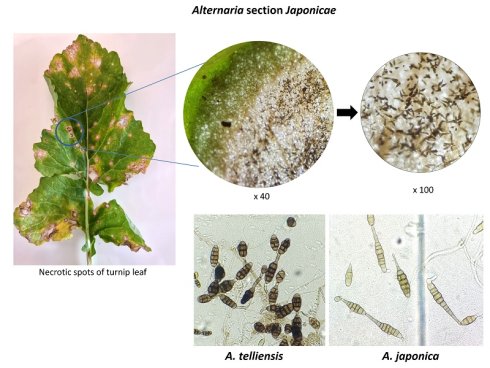
Species of Alternaria are necrotrophic fungi responsible for leaf spot diseases on a wide range of cultivated and wild plants. Species delimitation within this genus, however, often relies on morphological features and a limited set of molecular markers, which can constrain phylogenetic resolution at finer taxonomic scales. This is the case for Alternaria telliensis, a species recently described from Algeria and subsequently reported in Iran, whose relationships within section Japonicae require clarification. To provide a higher resolution framework for this species, we performed whole-genome sequencing, assembly, and BUSCO completeness assessment for type strains of A. telliensis (CBS 145643) and A. japonica (CBS 118390), using Oxford Nanopore Technologies MinION sequencing. The genome assembly of A. telliensis spans 34.4 Mbp across 132 contigs, with an N50 of 2.2 Mbp and a GC content of 50.94%. The A. japonica assembly comprises 33.5 Mbp in 196 contigs, with an N50 of 1.6 Mbp and a GC content of 51.47%. Phylogenomic analysis places A. telliensis alongside A. japonica within section Japonicae. These genomic data support the classification of A. telliensis and contribute to clarifying taxonomic relationships within the genus Alternaria.
Keywords: Alternaria telliensis, Alternaria japonica, nanopore sequencing, genome assembly
Introduction
Alternaria telliensis was originally described from Solanaceae in northwestern Algeria and subsequently reported as a causal agent of cabbage leaf spot in Iran [1,2]. Preliminary characterization of this species relied on morphological analyses combined with multi-locus phylogenies (ITS, GPD, RPB2, TEF1), which placed it within section Japonicae, alongside A. japonica. However, when mono-locus phylogenies based on ITS or GPD were applied, A. telliensis grouped with members of section Ulocladioides.
Whole-genome sequencing provides a higher-resolution framework for addressing the taxonomic ambiguity. Phylogenomic analyses based on single-copy orthologous genes can capture broader evolutionary signal than analyses based on a few loci. The genus Alternaria was initially divided into 24 sub-generic sections [3] and now comprises 30 sections and 9 monotypic lineages. More than 280 Alternaria genome sequences are publicly available in NCBI database. However, 73% are from members of section Alternaria and the remaining are divided into ten additional sections and one monotypic lineage. Unfortunately, no genome sequence from species of section Japonicae is currently available although species within this section might represent a threat for Brassicaceae crops.
This study aimed to generate whole-genome assemblies of the type strain of A. telliensis (CBS 145643) and A. japonica (CBS 118390) and reconstruct their phylogenomic relationships with selected Alternaria species.
Materials and Methods
Genomic DNA was extracted from frozen mycelium cultured for 7 days on Potato Dextrose Agar (PDA) medium on a pectocellulosic membrane after bead grinding, following a high-molecular weight fungal DNA extraction protocol for filamentous fungi [4]. DNA quality and purity were assessed using a NanoDrop spectrophotometer and DNA concentration was confirmed by fluorometric quantification using a Qubit dsDNA HS Assay Kit (Thermo Fisher Scientific).
Whole-genome sequencing was performed using the Oxford Nanopore Technologies MinION (ONT) platform with the Native Barcoding Kit V14 (SQK-NBD114.24) and the flowcell FLO-MIN114 with R10.4 pores [5]. The basecalling was performed on MinKNOW (v25.03.9) with the Dorado software (v7.8.3). Nanopore reads were filtered for quality and length using NanoFilt with a minimum quality threshold of Q >= 10 and a minimum read length of 1,000 bp. Read quality was assessed using NanoStat and NanoPlot from the NanoPack toolkit [6]. De novo assembly was performed with Flye (v2.9.6) using raw long reads, an estimated genome size of 31 Mb and three iterations [7]. The initial assemblies were improved through three successive polishing cycles with Racon (v1.5.0) [8]. For each polishing cycle, reads were aligned to the assembly using minimap2 (v2.24) in Oxford Nanopore mode [9].
Assembly quality before and after polishing was evaluated using QUAST v5.3.0 [10]. Assembly completeness was estimated using BUSCO (v6.0.0) against the dothideomycetes_odb10 lineage dataset (3,786 BUSCO groups) [11], using miniprot as the gene predictor. The assemblies of A. telliensis and A. japonica contained 3,766 (99.5%) and 3,769 (99.6%) complete BUSCOs, respectively. Overall assembly statistics were generated using SeqKit [12].
Structural gene prediction was performed using Funannotate v1.8.17. The soft-masked genome assembly was used as input. Protein evidence was generated by aligning a reference protein database containing 560,728 proteins against the genome using DIAMOND and Exonerate. Ab initio gene predictors (Augustus, GlimmerHMM, and SNAP) were trained on BUSCO derived gene models (fungi_odb10 lineage dataset) identified within the assembly. Gene model consensus was generated using EvidenceModeler (EVM), combining predictions from Augustus (weight = 1), high-quality Augustus predictions (weight = 2), GlimmerHMM (weight = 1), and SNAP (weight = 1). Gene models shorter than 50 amino acids, spanning assembly gaps, or corresponding to transposable elements were removed. tRNA genes were predicted using tRNAscan-SE.
A comparative genomic dataset was constructed using selected Alternaria genome assemblies retrieved from the NCBI GenBank database. The dataset included representatives of ten Alternaria sections (plus one monotypic lineage) and Stemphylium lycopersici (GCA 003268315.1) as outgroup. The assemblies used for comparison are listed in Table S1. All comparative analyses were performed on the concatenated alignment of 5,399 single-copy orthologous genes in the comparative dataset. Orthologous gene clustering was performed using OrthoFinder (v2.5.2) [13]. Protein sequence similarity searches were conducted with DIAMOND [14], and orthogroup delineation used Markov clustering of protein similarity relationships [15]. Multiple sequence alignments were generated for each inferred orthogroup using MAFFT v7 [16].
The species phylogeny was reconstructed under the maximum-likelihood framework using IQ-TREE v2.2.2.7 [17]. The best-fit substitution model was Q.plant+F+I+R8, selected according to the Bayesian Information Criterion in ModelFinder [18]. Branch support was assessed using ultrafast bootstrap analysis with 1,000 replicates and the SH-aLRT test with 1,000 replicates [19,20].
Results and Discussion
Nanopore read distributions were visualized for Alternaria telliensis and A. japonica using NanoPlot (Figure S1). The Nanopore read dataset for A. telliensis contained 382,467 reads and 1,260,768,324 bases, whereas the A. japonica dataset contained 570,917 reads and 1,780,512,442 bases. Estimated sequencing coverages were approximately 36.6x for A. telliensis and 53.1x for A. japonica (Table 1). The two datasets had similar mean read qualities, with Q22.5 for A. telliensis and Q22 for A. japonica.
Assembly statistics for Alternaria telliensis and A. japonica.
| Strain | Contigs | Largest contig (bp) | Total length (bp) | GC content (%) | N50 (bp) | Coverage(x) | Number of predicted genes |
|---|---|---|---|---|---|---|---|
| A. japonica | 196 | 5,995,486 | 33,509,493 | 51.47 | 1,655,298 | 53.1 | 9,522 |
| A. telliensis | 132 | 3,841,795 | 34,408,234 | 50.94 | 2,186,759 | 36.6 | 9,703 |
The A. telliensis genome assembly had a total length of 34,408,234 bp distributed across 132 contigs, with a GC content of 50.94%. Its largest contig was 3,841,795 bp, and its N50 and N90 were 2,186,759 bp and 525,007 bp, respectively. The A. japonica assembly had a total length of 33,509,493 bp distributed across 196 contigs, with a GC content of 51.47%. Its largest contig was 5,995,486 bp, and its N50 and N90 were 1,655,298 bp and 351,347 bp, respectively. BUSCO analyses revealed highly complete assemblies, the A. telliensis genome contained 99.5% complete BUSCOs, whereas the A. japonica genome contained 99.6% complete BUSCOs. Neither assembly contained ambiguous bases, with N's per 100 kbp equal to zero. These results are consistent with what has been reported for species of the genus Alternaria whose genome sizes varied from 31 Mbp (A. brassicicola) to 40 Mbp (A. metachromatica) with an estimated number of genes varying from 10,000 (A. dauci) to 13,000 (A. linariae) [21].
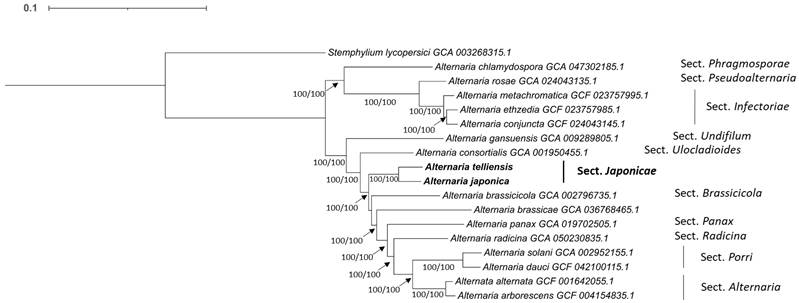
The maximum-likelihood phylogenomic tree reconstructed from the concatenated alignment of single-copy orthologous genes across the comparative dataset was consistent with the established sectional classification within the genus Alternaria, with all major sections recovered as well as the monotypic lineage A. brassicae. A. telliensis and A. japonica were placed within section Japonicae with maximum bootstrap support (100%) (Figure 1). This placement supports the assignment of A. telliensis to section Japonicae.
Phylogenomic tree constructed by the maximum likelihood (ML) method from the concatenated alignment of single-copy orthologous genes, illustrating the relationships between the different species of the Alternaria sections. Stemphylium lycopersici (GCA 003268315.1) was used as outgroup. Numbers at nodes indicate SH-aLRT support (%) / ultrafast bootstrap (UFBoot) support (%), based on 1,000 replicates each.
This study constitutes the first genome sequence report for two Alternaria species of section Japonicae that are both considered dangerous for Brassicaceae plants. Although A. japonica has been reported worldwide, records of A. telliensis are recent and, up to now, restricted to Algeria and Iran. Future comparative studies with available genome sequences from other important pathogens of Brassicaceae such as A. brassicae and A. brassicicola may contribute to identify key determinants of pathogenicity for these Alternaria species.
Supplementary Material
Supplementary figure and table.

Acknowledgements
This research is part of R Barkat's doctoral studies supported by the Program Hubert Curien “Tassili” between France and Algeria, BRASALT project No 24MDU104 and by the University of Angers as part of a financial package for co-supervised PhDs. The authors are grateful to Muriel Bahut (UMR IRHS, ANAN platform) for her support with genome sequencing.
Data availability
This Whole Genome Shotgun project has been deposited in DDBJ/ENA/GenBank under the accession no. JCBLRW000000000 and JCBLRX000000000 for A. japonica CBS 118390 and A. telliensis CBS 145643, respectively. The versions described in this paper are the first versions.
Competing Interests
The authors have declared that no competing interest exists.
References
1. Bessadat N, Hamon B, Bataille-Simoneau N, Mabrouk K, Simoneau P. Alternaria telliensis sp. nov, a new species isolated from Solanaceae in Algeria. Phytotaxa. 2020;440:89-100 doi:10.11646/phytotaxa.440.2.1
2. Poursafar A, Ghosta Y, Azizi R. Alternaria telliensis, a new causal agent of cabbage leaf spot disease in Iran. Mycologia Iranica. 2021;7(2):231-9 doi:10.22092/MI.2021.123906
3. Woudenberg JHC, Groenewald JZ, Binder M, Crous PW. Alternaria redefined. Stud Mycol. 2013 75 (1), 171-212. doi:10.3114/sim0015
4. Möller EM, Bahnweg G, Sandermann H, Geiger HH. A simple and efficient protocol for isolation of high molecular weight DNA from filamentous fungi, fruit bodies, and infected plant tissues. Nucl Acids Res. 1992;20(22):6115-6 doi:10.1093/nar/20.22.6115
5. Sereika M, Kirkegaard RH, Karst SM, Michaelsen TY, Sørensen EA, Wollenberg RD, Albertsen M. Oxford Nanopore R10.4 long-read sequencing enables the generation of near-finished bacterial genomes from pure cultures and metagenomes without short-read or reference polishing. Nat Methods. 2022;19(7):823-6 doi:10.1038/s41592-022-01539-7
6. De Coster W, D'Hert S, Schultz DT, Cruts M, Van Broeckhoven C. NanoPack: visualizing and processing long-read sequencing data. Bioinformatics. 2018;34(15):2666-9 doi:10.1093/bioinformatics/bty149
7. Kolmogorov M, Yuan J, Lin Y, Pevzner PA. Assembly of long, error-prone reads using repeat graphs. Nat Biotechnol. 2019;37(5):540-6 doi:10.1038/s41587-019-0072-8
8. Vaser R, Sović I, Nagarajan N, Šikić M. Fast and accurate de novo genome assembly from long uncorrected reads. Genome Res. 2017;27(5):737-46 doi:10.1101/gr.214270.116
9. Li H. Minimap2: pairwise alignment for nucleotide sequences. Birol I, editor. Bioinformatics. 2018;34(18):3094-100 doi:10.1093/bioinformatics/bty191
10. Mikheenko A, Saveliev V, Hirsch P, Gurevich A. WebQUAST: online evaluation of genome assemblies. Nucl Acids Res. 2023;51(W1):W601-6 doi:10.1093/nar/gkad406
11. Simão FA, Waterhouse RM, Ioannidis P, Kriventseva EV, Zdobnov EM. BUSCO: assessing genome assembly and annotation completeness with single-copy orthologs. Bioinformatics. 2015;31(19):3210-2 doi:10.1093/bioinformatics/btv351
12. Shen W, Sipos B, Zhao L. SeqKit2: A Swiss army knife for sequence and alignment processing. iMeta. 2024;3(3):e191 doi:10.1002/imt2.191
13. Emms DM, Kelly S. OrthoFinder: phylogenetic orthology inference for comparative genomics. Genome Biol. 2019;20(1):238 doi:10.1186/s13059-019-1832-y
14. Buchfink B, Xie C, Huson DH. Fast and sensitive protein alignment using DIAMOND. Nat Methods. 2015;12(1):59-60 doi:10.1038/nmeth.3176
15. Enright AJ. An efficient algorithm for large-scale detection of protein families. Nucl Acids Res. 2002;30(7):1575-84 doi:10.1093/nar/30.7.1575
16. Katoh K, Standley DM. MAFFT Multiple Sequence Alignment Software Version 7: Improvements in Performance and Usability. Mol Biol Evol. 2013;30(4):772-80 doi:10.1093/molbev/mst010
17. Nguyen L, Schmidt HA, Von Haeseler A, Minh B. IQ-TREE: A Fast and Effective Stochastic Algorithm for Estimating Maximum-Likelihood Phylogenies. Mol Biol Evol. 2015;32(1):268-74 doi:10.1093/molbev/msu300
18. Kalyaanamoorthy S, Minh B, Wong TF, Von Haeseler A, Jermiin L. ModelFinder: fast model selection for accurate phylogenetic estimates. Nat Methods. 2017;14(6):587-9 doi:10.1038/nmeth.4285
19. Guindon S, Dufayard JF, Lefort V, Anisimova M, Hordijk W, Gascuel O. New Algorithms and Methods to Estimate Maximum-Likelihood Phylogenies: Assessing the Performance of PhyML 3.0. Syst Biol. 2010;59(3):307-21 doi:10.1093/sysbio/syq010
20. Hoang DT, Chernomor O, Von Haeseler A, Minh BQ, Vinh LS. UFBoot2: Improving the Ultrafast Bootstrap Approximation. Mol Biol Evol. 2018;35(2):518-22 doi:10.1093/molbev/msx281
21. Paudel R, Muzhinji N, Pandey A, Panthee DR, Dean RA, Louws FJ. et al. Genome assembly and comparative analysis of Alternaria linariae reveal novel genes associated with host colonization and virulence. BMC Genomics. 2025;26(1):638 doi:10.1186/s12864-025-11819-z
Author contact
Corresponding author: Philippe Simoneau (simoneaufr).